Understanding OSI layers from Security View – Introduction
admin
Jun 19, 2023
 3 min Read
 Shares

The OSI model, or the Open Systems Interconnection model, is a conceptual framework that standardizes and describes the functions of a communication system. It was developed by the International Organization for Standardization (ISO) in the late 1970s to facilitate interoperability between different computer systems and networks. The OSI model is composed of seven distinct layers, each serving a specific purpose and responsible for a particular aspect of data communication. These layers work together to enable communication between devices and ensure that data is transmitted accurately and efficiently across a network.
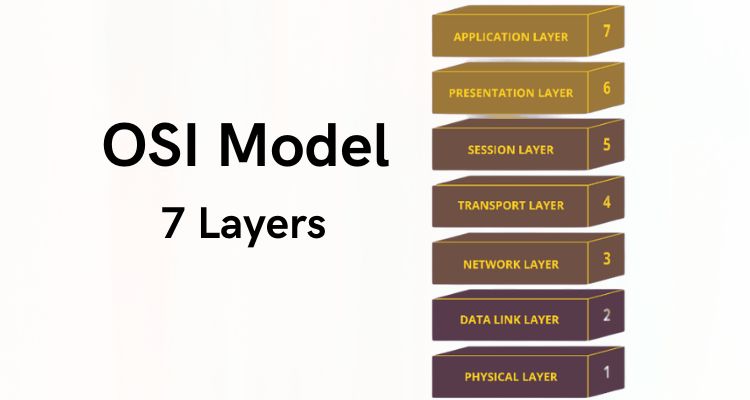
Let’s briefly explore each layer:
- Physical Layer: This is the lowest layer of the OSI model and deals with the physical transmission of data over a communication medium. It defines the electrical, mechanical, and physical specifications required to establish and maintain a physical link between network devices.
- Data Link Layer: The data link layer provides a reliable point-to-point connection for data transmission. It handles error detection and correction, as well as data framing, addressing, and flow control. Ethernet and Wi-Fi are examples of data link layer protocols.
- Network Layer: The network layer is responsible for the routing and forwarding of data packets across different networks. It determines the optimal path for data transmission, performs logical addressing, and handles congestion control. IP (Internet Protocol) is a widely used network layer protocol.
- Transport Layer: The transport layer ensures reliable and transparent end-to-end data transfer between hosts. It establishes connections, segments data into smaller units, manages flow control, and provides error recovery mechanisms. TCP (Transmission Control Protocol) and UDP (User Datagram Protocol) are common transport layer protocols.
- Session Layer: The session layer establishes, maintains, and terminates connections between applications on different network devices. It enables synchronization, checkpointing, and recovery of communication sessions.
- Presentation Layer: The presentation layer is responsible for data representation, encryption, compression, and formatting. It ensures that data from the application layer is properly formatted and compatible with the receiving device.
- Application Layer: The application layer is the topmost layer and interacts directly with end-user applications. It provides network services and supports protocols for specific applications, such as HTTP (Hypertext Transfer Protocol) for web browsing and SMTP (Simple Mail Transfer Protocol) for email.
By dividing the network communication process into these seven layers, the OSI model allows for modular design, easier troubleshooting, and the ability to replace or upgrade individual layers without affecting the entire system.
Understanding the OSI model and its layers is crucial for network administrators, engineers, and anyone involved in designing, implementing, or troubleshooting computer networks. It provides a common reference point for communication protocols and helps ensure interoperability in complex network environments.
Audit-Ready PCI DSS
Don’t risk fines. Let our QSA team guide your certification process smoothly.
Request Consultation NDA Available
Popular Articles


Other Blogs
 Previous

 Blog
ISO/IEC 27701:2025 Transition: What Organizations Need to Know
ISO/IEC 27701 has entered a new phase. Published on 14 October 2025, ISO/IEC 27701:2025 replaces…
Read More Blog
PCI KMO Standard v1.0: What It Means for Payment Security
Learn what PCI KMO Standard v1.0 covers, who it affects, how it supports PIN and…
Read More Blog
Firewall Ruleset Review: What Your Rules Are Really Allowing
Every firewall does exactly what its rules tell it to do - nothing more. A…
Read More Blog
CEA Cyber Security Regulations 2026: Compliance Guide
The Central Electricity Authority (Cyber Security in Power Sector) Regulations, 2026 create an auditable cyber…
Read More Blog
Incident Response Planning for Regulated Entities in India
Every regulated entity has an incident response plan. It sits in a policy document, usually…
Read More Blog
AI Governance and Compliance in Indian Financial Services
Indian banks, NBFCs, and insurance companies are deploying AI across credit scoring, fraud detection, customer…
Read More Blog
FAQ: Cloud Compliance Questions From Fintech CTOs
Any cloud provider with data center regions in India - AWS (Mumbai and Hyderabad), Azure…
Read More Blog
RBI Cybersecurity Directions 2026: A Complete Compliance Guide
RBI's approach to cybersecurity regulation has evolved from advisory circulars to mandatory directions. The regulatory…
Read MoreReady to become compliant?
Talk to QRC to understand your scope, close gaps, and move confidently
toward validation readiness.