Controls Guide for ISO 27001 – Part 1

This article is part of our ISO 27001 compliance and certification hub page, created to help organizations understand the standard, its requirements, and its role in information security management. In this first part of the ISO 27001 controls guide, we explain the foundational controls that support risk management, data security, and a structured approach to protecting business-critical information.

An international standard called ISO/IEC 27001:2013 was developed to assist enterprises in managing the security procedures for their information assets. This standard offers a reliable framework for putting into place an ISMS, or Information Security Management System. Through its safe and efficient management procedures, this framework facilitates the Confidentiality, Integrity, and Availability of all crucial organizational data.

One of the most widely used and approved information security standards is ISO 27001. You can refer to our prior article for more information because we already covered everything you need to know about the ISO 27001 standard. The focus of this essay is on the ISO 27001 Audit Controls, nevertheless. The paper describes the ISO27001 Audit Controls in great detail.

What are the audit controls for ISO 27001?

There are two sections to the ISO 27001 Audit Control Standards.11 clauses, ranging from 0 to 10, make up the first section, which is the required element. 114 control objectives and controls are outlined in the second section, known as Annex A. The Introduction, Scope, Normative references, and Terms and Definitions of the ISO 27001 standard are covered in Clauses 0 to 3.

Any business that wants to be in compliance with the Standard must adhere to the ISO 27001 requirements listed in Clauses 4 through 10. The Standard’s Annex A provides a list of optional controls that are chosen as part of the Risk Management process to support these clauses and their requirements. 14 categories can be used to group the 114 controls in ISO 27001 Annex A, which we will explore below.

ISO/IEC 27001 Information Security Management Standard – Clauses 0 – 10

  1. Clause 0.1: Introduction  – The knowledge needed to put up a successful Information Security Management System is provided by the ISO 27001 Standard. This system provides an overview of how the standard implementation safeguards your data from unauthorized  users, complies with numerous national and international compliance standards, and inspires confidence in stakeholders and clients as a reliable business.
  2. Clause 1: Scope  – According to this clause, your organization’s context must be considered when applying the ISO 27001 standard’s specifications. So it’s crucial to understand your organizational  setting. This prevents you from overworking your system and attempting to accomplish goals that are unnecessary. It is stated again in the provision that your ISMS must apply risk management procedures. It also demonstrates how this norm applies to businesses of all sizes.
  3. Clause 2: Normative references  – This Clause exists to indicate that application of ISO 27001 requires ISO 27000. As a result, while developing your ISMS, you must read, comprehend, and apply the criteria of ISO 27000.
  4. Clause 3: Terms and Conditions  – The fact that all the criteria and conditions stated in this Clause also apply to ISO 27001 is another crucial reason why you should first grasp ISO 27000.
  5. Clause 4: Context of the organization  – This clause mandates that the organisation identify all internal and external concerns that might be pertinent to its business goals and the realization  of the ISMS’s own objectives.
  6. Clause 5: Leadership  – To ensure a seamless implementation of the ISMS, this clause mandates that top management duties be clarified, along with the roles and responsibilities and the contents of the top-level Information Security Policy.
  7. Clause 6: Planning  – The “preventive action” described in the previous version of ISO 27001:2005 is covered by clause no. 6. It lays out exactly what is needed in terms of risk assessment, risk management, Statements of Applicability, and Risk Treatment Plans, as well as how these fit together and make it easier to set up the ISMS.
  8. Clause 7: Support  – The next clause specifies that the organisation must establish and make resources necessary by the ISMS team to the team deploying the system available in order to achieve the specified objectives and demonstrate constant improvement. It aims to outline the prerequisites for resource accessibility, skill levels, awareness, communication, and document and record control.
  9. Clause 8: Operation  – This clause aims to guarantee that security goals are reached, risks and opportunities are handled appropriately, and information security regulations are adhered to. It outlines how risk assessment should be implemented as well as other procedures required to meet information security goals.
  10. Clause 9: Performance evaluation  – This clause addresses the ongoing measurement, analysis, performance assessment, and monitoring of the ISMS. These practices are critical components of an effective IS audit.  As a result, this Clause aims to provide precise measuring metrics by defining the standards for the organization’s monitoring, measurement, analysis, evaluation, internal audit, and management review.
  11. Clause 10: Improvement  – The requirements for nonconformities, corrections, corrective actions, and continuous improvement are outlined in this section.

Continue reading Here

How can SaaS companies benefit from ISO 27001?

Information security concerns are unavoidably sparked by the use of cloud environments. Users anticipate that the information they store—including sensitive, private, and customer information—will be kept secure. They want to carefully select a service provider so that they can rest easy knowing that their data is safe. As a result, it is envisaged that SaaS companies would be successful, reliable, and provide security measures.
The widely used international standard on information security management systems, ISO 27001, can be useful in this situation. Clients are reassured that the SaaS provider takes security and compliance seriously by the implementation of sufficient ISO 27001 procedures. There is a considerable likelihood that potential clients won’t even shortlist a SaaS provider if it lacks ISO 27001 certification.
The following reasons that ISO 27001 accreditation benefits SaaS Companies: 
  • Delivers systems and applications that are architected to be reliable and extremely secure.
  • By utilising the concepts of confidentiality, integrity, and availability, allows its users the freedom to own and control their data.
  • Complies with service-level agreements, ensuring the continuation of services and business
  • Outlines laws and other rules relating to information
The advantages of ISO 27001 for a SaaS Companies 
In addition to denoting trustworthy recognition, ISO 27001 for SaaS guarantees effectiveness inside a business, boosting customer retention and attracting new clients. Because of the following reasons, more SaaS organisations are attempting to get a competitive edge over their rivals by showcasing their dedication to data security:
  • Since they provide well-designed, trustworthy, and highly secure systems and apps, many businesses view ISO 27001 as a fundamental security criteria when choosing their SaaS vendor.
  • By implementing the principles of confidentiality, integrity, and availability, SaaS with ISO 27001 certification gives its users ownership and control over their data.
  • The risk management strategy of ISO 27001 enables SaaS providers to uphold their service-level agreements, ensuring SaaS customers’ access to services and business continuity in the event of an incident or disruption.
  • Identification of laws and other information-related legislation is required by ISO 27001. In order to give their clients peace of mind that their supplier is not exposed to any legal risk, ISO 27001-certified SaaS firms take this into consideration while creating their systems.
Certification criteria for ISO 27001 for SaaS Companies
A SaaS organisation must put in place a security framework and safeguards before applying for certification they are done in the 16 steps outlined in the following article: Checklist for implementing ISO 27001 The SaaS company will be qualified for the initial certification procedure after completing the implementation’s final steps, internal audit(s) and management review(s), and initiating corrective actions.
How is client data protection ensured by ISO 27001 certification? 
As previously noted, ISO 27001 provides a list of security measures that guarantee client data is safe. The following 14 sections are used to group these controls:
  • A.5 Information security policies: Policies instruct staff members and other parties about the key security principles and the goals an organisation hopes to accomplish with an information security system.
  • A.6 Organization of information security: Everyone will be able to understand their obligations and prevent conflicts in an organisation with well defined security positions. Additionally, establishing guidelines for using mobile devices and teleworking will lower the likelihood of violations.
  • A.7 Human resource security: Ensure that the organisation employs only dependable personnel who receive regular training and are aware of their obligations.
  • A.8 Asset management: Infrastructure, contracts, and database assets should all be categorized in an inventory and monitored for usage and any changes.
  • A.9 Access control: Make sure that permissions on who may access what information and how are handled in a secure manner because different customers or users will require different responsibilities.
  • A.10 Cryptography: SaaS data encryption is crucial because it ensures that data is protected from hackers and prying eyes while it is in storage or in transit. The best method to ensure data security is to use SaaS services that adhere to the necessary data encryption standards.
  • A.11 Physical and environmental security: It is essential to safeguard workspaces, rooms, and equipment. When choosing safeguards, one must take into account the location of the workplace, natural disasters, hostile assaults, cabling security, and equipment maintenance. SaaS businesses must have entrance limitations and safeguards against illegal access to information. Even small businesses with remote workers must have guidelines protecting their laptops, smartphones, thumb drives, and screen-clearing procedures.
  • A.12 Operations security: SaaS organisations must make sure they have enough capacity and the flexibility to make changes as necessary in order to fulfil client demand. Malware defence, backup administration, and recording of admin and user activity as well as security events are further operation security controls.
  • A.13 Communications security: In order to safeguard the data included in systems and apps, SaaS providers must monitor and regulate networks. SaaS applications must be protected by technical measures such firewalls, endpoint verification, network segregation, hosting, non-disclosure agreements, third-party extensions, and libraries.
  • A.14 System acquisition, development and maintenance: There should be specified guidelines that are applied to software and system developments within SaaS companies. Tests must be run to ensure everything is in order before going live.
  • A.15 Supplier relationships: SaaS organisations should only work with vendors who are aware of their security responsibilities.
  • A.16 Information security incident management: Prior to an issue occurring, SaaS organisations should build an incident management and response plan.
  • A.17 Information security aspects of business continuity management: When it comes to avoiding scenarios that will inevitably disrupt corporate operations, preparation is essential. The organisation will maintain control and lower disruption, damage, recovery time, and costs by defining important tasks and creating step-by-step procedures to resume regular operations.
  • A.18 Compliance: Laws and regulations must be followed by any corporate entity. SaaS businesses need to pay close attention to laws governing technical compliance, intellectual property rights, and privacy.
What role does ISO 27001 certification play in SaaS enterprises gaining market share? 
For SaaS businesses looking to gain international recognition and gain a competitive edge in a field that is expanding quickly and where security is the biggest problem, ISO 27001 is a fantastic place to start. Therefore, acquiring a new client will be considerably simpler if a SaaS company receives ISO 27001 accreditation.

Focus Areas of ISO/IEC 27001:2013

Information security management system ISO 27001 (formerly known as ISO/IEC 27001:2005) specification (ISMS). The legal, physical, and technical controls involved in an organization’s information risk management processes are all part of an ISMS, which is a framework of rules and procedures. For the purpose of “providing a model for establishing, implementing, operating, monitoring, reviewing, maintaining and enhancing an information security management system,” ISO 27001 was created, according to its literature.

Technology-neutral and top-down, ISO 27001 follows a risk-based methodology. A six-step planning procedure is outlined in the specification:

  • Define a security policy.
  • Define the scope of the ISMS.
  • Conduct a risk assessment.
  • Manage identified risks.
  • Select control objectives and controls to be implemented.
  • Prepare a statement of applicability.

The specification includes details for documentation, management responsibility, internal audits, continual improvement, and corrective and preventive action. The standard requires cooperation among all sections of an organisation.

The 27001 standards does not mandate specific information security controls, but it provides a checklist of controls that should be considered in the accompanying code of practice, ISO/IEC 27002:2005. This second standard describes a comprehensive set of information security control objectives and a set of generally accepted good practice security controls.

ISO 27002 contains 12 main sections:

  1. Risk assessment
  2. Security policy
  3. Organization of information security
  4. Asset management
  5. Human resources security
  6. Physical and environmental security
  7. Communications and operations management
  8. Access control
  9. Information systems acquisition, development and maintenance
  10. Information security incident management
  11. Business continuity management
  12. Compliance

Organizations must implement these measures correctly in accordance with their unique risks. For ISO 27001 compliance, third-party recognized certification is advised. Organizations must implement these measures in a way that is appropriate for their particular risks. For compliance with ISO 27001, third-party authorized certification is advised.

GDPR: When should you obtain consent?

Knowing how to obtain consent under the General Data Protection Regulation (GDPR) and when to do so might be challenging. Many individuals wrongly believe that organisations must obtain consent before processing personal data however, consent is simply one of six legal justifications, and you should only use it if all other options have been exhausted.

Other acceptable grounds include:  A contract with the person, such as one under which obligations under an employment contract must be fulfilled or goods or services must be provided as per their desire. When processing data for a certain purpose is required by law, compliance is required. Vital interests, such as protecting someone’s physical integrity or life (either the data subject’s or another person’s), are examples of vital interests. An official function or duty that serves the public interest is an example of a public task. This often applies to public institutions including government agencies, educational institutions, hospitals, and the police.

Legitimate interests: When a private-sector organisation has a true and legitimate reason (including a financial profit) to process a person’s personal data without their consent, provided that this reason does not exceed any detrimental consequences on the person’s rights and freedoms. You need to be aware of your responsibilities since there may be circumstances in which permission is the most suitable legal basis.

Opt In vs Opt Out

The GDPR specifies conditions for legitimate requests for consent, but consent must also be given with a definite affirmative response. In other words, rather than pre-ticked boxes, people need a method that demands a deliberate decision to opt in. The ICO (Information Commissioner’s Office) asserts that opt-out alternatives “are effectively the same as pre-ticked boxes, which are outlawed,” even though the GDPR does not expressly forbid opt-out consent.

Examples of demands for valid consent include:

  • Signing a consent statement on a paper form
  • Clicking an opt-in button or link online
  • Selecting from equally prominent yes/no options
  • Choosing technical settings or preference dashboard settings
  • Responding to an email requesting consent
  • Answering yes to a clear oral consent request
  • Volunteering optional information for a specific purpose (such as optional fields in a form)
  • Dropping a business card into a box

The issue is that in order for a request for consent to be valid, the person must clearly take an affirmative action. Consent requests must not in any way rely on silence, passivity, default configurations, exploiting indifference or inertia, or default prejudice.

Problems with consent :  Because individuals now have more control over their data under the GDPR, relying on consent can be risky and time-consuming. For instance, you will need to obtain everyone’s approval once more if you are processing personal data with their consent and later decide to use that data for a different purpose. You must delete from your files anyone who declines or doesn’t respond.

Furthermore, people have the right to withdraw their consent at any moment, which once again requires you to delete them from your database. If you don’t do this, the relevant supervisory authority may discipline your organisation.

Additionally, you may find yourself in a catch-22 situation if a data subject withdraws their consent and you later realize you are required by law to continue processing the data. In other words, you either fail to fulfil your legal obligation to handle the data or you are compelled to violate privacy law by processing the data after consent has been withdrawn.

Everything you need to know about HIPAA

Health Insurance Portability and Accountability Act of 1996 (HIPAA) is a federal law, mainly focused on protecting sensitive patient health information from being disclosed without the patient’s consent or knowledge. The law that provides baseline privacy and security standards for medical information of US citizens and included Administrative Simplification provisions that required HHS to adopt national standards for electronic health care transactions and code sets, unique health identifiers, and security

Healthcare information regulated by HIPAA is called protected health information (PHI). PHI is any demographic information that can be used to identify a patient. PHI can include a patient’s name, address, Social Security Number, insurance ID number, medical record, full facial photograph, and others.

HIPAA compliance involves fulfilling the requirements of the HIPAA of 1996, it’s subsequent amendments, and any related legislation such as the Health Information Technology for Economic and Clinical Health (HITECH) Act.

Applicability of HIPAA

Under HIPAA regulation, there are two classes of healthcare organizations that must be HIPAA compliant. These are:-

Covered Entity– A covered entity is a health care provider, a health insurance plan or a health care clearing houses whose activity is to creates, maintains or transmits PHI. Most health care providers employed by a hospital are not covered entities. The hospital is the covered entity and responsible for implementing and enforcing HIPAA complaint policies. Examples like

Business Associate– Person or business that provides a service to or performs a certain function or activity for a covered entity when that service, function or activity involves the business associate having access to PHI maintained by the covered entity. Examples like IT Managed Services, Hosting providers, Medical Transcription Services, Billing Services etc.,

HIPAA Rules:

Since HIPAA legislation passed in 1996, Department of Health and Human Services (HHS) added multiple Rules to protect patients Privacy and Security of the patients data.

HIPAA rules that require healthcare organizations — and their business associates — to protect patient privacy and secure patient data by ensuring technical, physical, and administrative safeguards are in place and adhered to, that they comply with the HIPAA Privacy Rule in order to protect the integrity of PHI, and that – should a breach of PHI occur – they follow the procedure in the HIPAA Breach Notification Rule.

HIPAA Compliance required on the following rules.

  1. Security Rule
    – Technical Safeguards
    – Physical Safeguards
    – Administrative Safeguards
  2. Privacy Rule
  3. Breach Notification Rule
  4. Omnibus Rule
  5. Enforcement Rule

The Security Rule sets national standards for protecting the confidentiality, integrity, and availability of electronic protected health information.

The HIPAA Privacy Rule governs how ePHI can be used and disclosed. In force since 2003, the Privacy Rule applies to all healthcare organizations, the providers of health plans (including employers), healthcare clearing houses and – from 2013 – the Business Associates of covered entities.

The Privacy Rule demands that appropriate safeguards are implemented to protect the privacy of Personal Health Information. It also sets limits and conditions on the use and disclosure of that information without patient authorization. The Rule also gives patients – or their nominated representatives – rights over their health information including the right to obtain a copy of their health records – or examine them – and the ability to request corrections if necessary.

Breach Notification Rule:

The HIPAA Breach Notification Rule sets standards for the process that covered entities and business associates must follow in the event of a breach. The HIPAA Breach Notification Rule requires covered entities to notify patients when there is a breach of their ePHI. The Breach Notification Rule also requires entities to promptly notify the Department of Health and Human Services of such a breach of ePHI and issue a notice to the media if the breach affects more than five hundred patients.

Omnibus Rule:

HHS enacted the  final Omnibus Rule  in 2013 to address policy gaps in earlier HIPAA rules. Most notably, the Omnibus Rule defines the role of business associates, which were not previously subject to HIPAA rules, and outlines the criteria for Business Associate Agreements (BAAs) which must be executed between organizations sharing PHI before any information is transferred, handled, or maintained.

Enforcement Rule:

The  Enforcement Rule  empowers HHS to enforce the Privacy and Security Rules. It gives OCR the authority to investigate HIPAA complaints, conduct compliance reviews, perform education and outreach, and  levy fines  of up to $1.5 million. OCR also works with the Department of Justice to refer possible criminal violations of HIPAA.  Read more about HIPAA Rules

Steps to became HIPAA Compliant:

  1. Implementing written policies, procedures, and standards of conduct.
  2. Designating a compliance officer and compliance committee.
  3. Conducting effective training and education.
  4. Developing effective lines of communication.
  5. Conducting internal monitoring and auditing.
  6. Enforcing standards through well-publicized disciplinary guidelines.
  7. Responding promptly to detected offenses and undertaking corrective action.

Need more insights ? Get in touch with our experts for any queries on HIPAA Assessment and Compliance.

What Is HIPAA Privacy Rule?

The Health Insurance Portability and Accountability Act of 1996 (HIPAA) is a law in the United States that was created to ensure the privacy and security of health data. The Privacy Rule, also known as the Standards for Privacy of Individually Identifiable Health Information, is one of the most important parts of HIPAA. It defines how healthcare providers, health plans, health care clearinghouses  and other entities covered by HIPAA can use and disclose an individual’s protected health information (PHI). 

The act also covers health care providers that conduct certain health care transactions electronically. 

The Privacy Rule limits uses and disclosures to certain circumstances: 

–  To provide treatment, 
–  For payment, 
–  For healthcare operations, 
–  For public health activities, 
–  In specialized government functions such as military or intelligence purposes, 
–  For research purposes with consent, or 
–  If required by law. 

The Privacy Rule requires covered entities to provide individuals with notice about their privacy practices, including how they use and disclose their personal health information. It also limits certain uses and disclosures of this information without an individual’s written authorization. The key standards outlined by the HIPAA Privacy Rule cover:

– Patients’ rights to access PHI
– Health care providers’ rights to deny access to PHI,
– Contents of Use and Disclosure  HIPAA release forms
– Notices of Privacy Practices, and more. 

The Privacy Rule gives individuals rights over their protected health information, including the right to examine and obtain a copy. The Rule also gives individuals the right to request in writing that an organization restrict uses or disclosures of their protected health information.  

The regulatory standards must be documented in the organization’s HIPAA Policies and Procedures. 

10 Essential Requirements of GDPR summarized

This article is part of our GDPR compliance hub page, created to help organizations understand core GDPR obligations and compliance expectations. In this blog, we summarize the 10 essential GDPR requirements businesses should know, from lawful data processing and consent management to data subject rights, breach notification, and accountability in handling personal information.

It’s understandable that the General Data Protection Regulation (GDPR) is a difficult piece of law to comprehend. In this blog, we’ve offered a summary of the major GDPR regulations for individuals looking for guidance on how to comply.

1.  Lawful, fair and transparent processing
According to Article 5 of the GDPR, organisations must have a legal basis for processing personal data that is documented, and individuals must be aware of how their data is being used and processed. That might sound simple, but according to a research from our sister organisation, IT Governance UK, infractions of Article 5 are the most frequently mentioned mistake in penalty notifications. By comparing your procedures to the GDPR’s permissible bases for processing, you may make sure that your processing is legal (more on that later).
You must produce privacy notices and make them available to data subjects if you want to ensure transparency.
2. Limitation of purpose, data and storage
Article 5 also stipulates that businesses may only gather individuals’ personal information for specified purposes. They must also specify that objective in writing and make sure that data is destroyed when it is no longer required.
More latitude is granted for processing that is done for public interest archiving, scientific, historical, or statistical objectives.
3. Data subject rights
Eight data subject rights are protected by the GDPR:
  • Right to be informed
    People have a right to know what information is being gathered, how it will be used, how long it will be stored, and whether it will be shared with outside parties.
    This information must be delivered succinctly and in an understandable manner.
  • Right of access
    People can submit DSARs (data subject access requests), which compel organisations to give them a copy of any personal information they may have about them. Although there are few exceptions for demands that are plainly baseless, repetitive, or excessive, organisations have a month to produce this information.
  • Right to rectification
    An individual has the right to ask that any inaccurate or incomplete information held about them by an organisation be rectified. The same limitations apply as with the right of access, and organisations have a month to complete this.
  • Right to erasure
    In some situations, such as when the data is no longer required, it was improperly processed, or it no longer satisfies the legal basis for collection, individuals have the right to request that organisations delete their personal data.
  • Right to restrict processing
    When people no longer use the product or service for which personal data was originally acquired but the organisation requires it to establish, exercise, or defend a legal claim, they have an alternative to the right to deletion known as the right to restrict processing. The organisation should therefore restrict how the information is utilized rather than delete it.
  • Right to data portability
    People are free to collect and utilize their personal data anyway they see fit across various services. This right only applies to personal information that a person has voluntarily or contractually disclosed to data controllers.
  • Right to object
    Organizations must provide individuals with the opportunity to object when processing personal data on the grounds of legitimate interest or carrying out a duty in the service of an official authority. Organizations must stop processing information if they exercise this right, unless they can provide a compelling cause for doing so that outweighs the interests, rights, and freedoms of the individual.
  • Rights related to automated decision making including profiling
    The GDPR has protections for decisions that are made automatically, like profiling, which analyses personal data to infer judgments about people. There are strong regulations governing this type of processing, and individuals are free to contest the processing and ask for a review if they think the regulations aren’t being followed.
4. Consent
It’s a common misperception that organisations must obtain individuals’ consent before processing personal data under the GDPR. In reality, there are only six legal reasons for permission, and it should only be used in certain circumstances. Organizations must adhere to specified guidelines when consent is most appropriate.
In essence, consent must be expressed through an obvious affirmative action. In other words, rather than pre-ticked boxes, people need a method that demands a deliberate decision to opt in.
5. Personal data breaches
Understanding exactly what is covered in this word is crucial because data breaches are at the core of the GDPR. An incident that results in the unintentional or unlawful destruction, loss, alteration, unauthorized disclosure of, or access to, personal data transmitted, stored, or otherwise processed is referred to as a personal data breach in Article 4.
This implies that data breaches aren’t necessarily the consequence of hackers breaking into a company’s computer systems. They can also happen when an employee accesses data that are unrelated to their job function, shares files with a third party outside the organisation, or sends an email with sensitive information to the incorrect recipient. Data breaches also include incidents like ransomware attacks or broken hardware that prevent organisations from accessing systems that contain personal data because it is no longer usable.
6. Privacy by design
Privacy by design is not a new idea it was previously regarded as best practise. With the GDPR, it is now required, though.
So what is it exactly? It asserts that organisations should take privacy concerns into account before implementing data processing procedures rather than doing so after the fact.
This requires organisations to:
  • Implement the right organisational and technical steps to put the data protection principles into practise
  • integrate safeguards to abide by the GDPR’s standards and protect the rights of individuals.
7. Data protection impact assessment
Article 35 introduces DPIAs as a concept (data protection impact assessments). These aid organisations in identifying and reducing privacy issues when processing data. They are crucial if you handle any high-risk data, but they are also important whenever you’re implementing a new system, procedure, or technology for data collection. DPIAs are required, according to the GPDR, in situations when processing data “is likely to result in a high danger to the rights and freedoms of natural persons.”
Although it doesn’t define “high risk,” it typically refers to the following:
  • Broad and systematic profiling
  • Large-scale statistics on a specific category or offence
  • large-scale, systematic observation of locations that are open to the public
8. Data transfers
Depending on where you are moving data to and from, different rules apply for data transfers. Organizations do not need to take any additional security precautions when transferring personal data inside the EU. However, one of the protections listed in Article 46 must be used if you are sending data to a third nation. SCCs (standard contractual clauses) are used in the majority of situations where organisations are straightforwardly sharing data with organisations headquartered outside of the EU. Two sets of SCCs for data transfers between data controllers and one set for data transfers between data controllers and data processors have so far been released by the European Commission.
9. Data protection officer
A DPO (data protection officer) is an impartial expert in data protection who advises a company on how to adhere to regulatory standards. Article 39 lists the prerequisites for a DPO, which include the following :
  • Educating employees about their obligations regarding data protection
  • Maintaining a close eye on the organization’s data protection rules and practises
  • Advising management of the necessity of DPIAs (data protection impact assessments)
  • Acting as the organization’s point of contact with its supervisory authority
  • Acting as a contact for people with regard to privacy issues
10. Awareness and training
Anyone who manages personal data or is in charge of monitoring data protection procedures must provide staff awareness training. Additionally, make sure that the training is applicable to the work that the personnel do. For instance, employees in charge of handling personal data should be educated about their duties and the risks involved. Along with the data protection policy, senior staff members should be taught key concepts, including privacy by design and DPIAs.

Understanding PCI SSF compliance standards and its benefits

To safeguard contemporary payment software, the PCI Security Standards Council (PCI SSC) published a new framework called the PCI Software Security Framework (SSF). The new framework is a group of guidelines and tools created to safeguard the creation of payment software. The current standard, PA DSS (Payment Application Data Security Standard), will soon become obsolete with the advent of SSF. Simply put, this means that the SSF replaces PA-DSS with more up-to-date specifications that accommodate a variety of payment software types, technologies, and development approaches. It is a novel strategy that extends the PA-DSS restrictions and supports both current and future payment software while addressing overall software security resilience.
The PCI Secure Software Standard and PCI Secure Software Lifecycle Standard serve as the foundation for the PCI Software Security Framework.
Secure Software Standard
The validation of payment software to Secure Program Standard (S3) ensures that the software is normally built to safeguard both the confidentiality of sensitive data it takes, stores, processes, and sends and the integrity of the software. Typically, this standard is applicable when:
  • Software solutions that store, process, or transmit data are directly involved in, directly support, or enable payment transactions.
  • Software items created by the vendor and offered for sale to numerous businesses.
Secure Software Lifecycle Standard
The PCI Secure SLC Standard is complied with by the vendor’s software development lifecycle methods, techniques, and practises thanks to the validation of payment software to Secure Software Life Cycle Standard. This standard’s scope of application includes:
  • All vendors who develop payment software.
Why PCI Software Security Framework Was Introduced to Replace PA DSS
Traditional and contemporary software security criteria are combined in the PCI Software Security Framework. The most recent framework covers software types, development processes, and changing technologies. With the goal of promoting highly objective security practises that support both the conventional approaches to effective application security and the most recent development practises, the new PCI SSF framework was created and put into place. It is a framework that was established to make sure vendors can have the best of both worlds and apply security measures that are most effective.
Transition from PA DSS to PCI SSF
Through the end of October 2022, PCI Council will continue to support PA DSS approved apps to provide a smooth transition from PA DSS to PCI SSF. The existing PA-DSS validated applications will continue to be listed on the “List of Validated Payment Applications” until their expiration dates, as promised, with no effect on users. Additionally, PCI Software Security Framework will take the place of PA DSS and its listings by the end of October 2022. Following the retirement of PA DSS in 2022, the payment application will be validated with PCI SSF thanks to this transition. The new framework gives all software providers flexibility and makes it easier to design secure applications in accordance with industry standards.
PCI SSF Compliance Benefits
The new SSF framework was created by the Payment Card Industry Security Standards Council to give software vendors freedom and to ensure that payment software is produced in accordance with the highest security standards possible. In contrast to PA-DSS, the SSF will assist numerous security initiatives and projects that put a priority on secure design and development. Following are some benefits of PCI SSF Compliance for Customers, Vendors, and Merchants in General:
  • A modular assessment architecture and technique are made possible by SSF Compliance, increasing flexibility.
  • Following the PCI Software Security Frame can help lower the risk of fines and complications from data breaches.
  • Compliance guarantees that the necessary security and protection measures are in place to secure the environment for card data.
  • It will guarantee that crucial assets are safeguarded and increase the application of access controls.
  • It serves as confirmation that the organisations are abiding by the law.
  • Customers can have faith that the company has made an effort to secure the environment and safeguard their data thanks to this.
  • Having a risk management approach in place and having business continuity plans in place are requirements for SSF compliance.
  • SSF Framework adherence ensures defence against new security risks and flexibility in response to any developments.
Final Reflections
Although the change from PA DSS to PCI SSF may appear difficult, it won’t matter and will actually hinder your efforts to comply with regulations. In reality, PCI SSF offers additional freedom for software developers to include payment application security in accordance with the most recent standards adopted by the market. Additionally, as was already noted, the PA-DSS and SSF Programs will continue concurrently, with the PA-DSS Program continuing to function as it does until the date of expiry. This will ensure a smooth transition for all parties involved. Having said that, we believe that the choice to implement a new framework is for the good of society as a whole as well as for customers and vendors. Consequently, the adoption of PCI SSF should not be seen negatively instead.

Top 8 Challenges to becoming SOC 2 Certified

SOC 2 on your mind? Here are a few difficult encounters on your journey to be SOC2 compliant

Is your company immune to cybercrimes?

Whether a large corporation, small business, start-up, or government agency, no one is immune to Cyber-attacks! Recent ransomware attacks sent an uninviting reminder of the vulnerability of online security issues. The Denver Post states that 60% of all cyber-attacks are targeted towards small and mid-sized businesses, and stats state that about 4,000 attacks are attempted per day! Small businesses are more at the receiving end due to the ease of penetration.

To such attacks, some businesses may be able to manage the recovery of their losses, but others may not be so lucky. Companies like Medstar Health (a chain of hospitals in Baltimore) entered the crisis after a hacking incident and lost all patients’ data. It had to suffer shutdowns later. Another recent example is one of the nationalized bank incidents where vulnerability puts critical financial and personal information of 180 million customers at risk. Although the bank has assured that customers’ data is not affected, the digital banking information of the bank was compromised with administrative controls. Therefore, Cybersecurity must be taken seriously by organizations. Place stringent compliance measures to avoid hefty fines/damages and assure customers that the supply chains are protected. That is why high-quality audits can protect and ensure good practices.

SOC2 audits are most preferred for such checks, due to the higher standards of controls it sets for mitigating and managing information risks. So, let us see what SOC2 is and how it helps in countering cyber security threats.

What Is SOC 2 Compliance?

SOC2 was developed by ‘The American Institute of Certified Public Accountants (AICPA). It is an audit process that defines standards for managing customer services and data securely. It lays down criteria for regular attestation of the controls in an organization so that there is continual mitigation of risks to demonstrate operating effectiveness. It is more like an assurance to the customers of the business, that there is the secure management of customer data across technical and business areas of the organization. SOC2 intends to give organizations a clear picture of how their data will be managed and handled to work with third-party service providers confidently. Mostly prepared for service organizations, it gives insights into non-financial reporting controls and concentrates on five trust services principles.

The SOC 2 defines criteria for managing customer data based on five “trust service principles”, namely :

  1. Security –  SOC2 requires organizations to have protection against unauthorized access, misuse of the software, system abuse, and theft of data.
  2. Availability –  SOC 2 requires that the service provider warrants service availability and accessibility to its users at all times for operations and use.
  3. Processing integrity –  This principle requires the organizations to complete, valid, accurate, timely, and authorized system processes.
  4. Confidentiality –  Needs the organization to protect confidential information with appropriate control measures.
  5. Privacy –  An SOC 2 compliance provider should develop mechanisms in conformity with privacy notice when collecting, using, retaining, disclosing, and disposing of personal information.

Challenges in the Journey of Being SOC2 Certified

SOC2 is important but challenging too. Here are a few pitfalls that must be thoughtfully handled while working to meet SOC2 compliance.

  1. Defining Scope Of SOC2 Report  SOC 2 Report should cover the systems and services that are in use by the clients and that require assurance. It depends much upon the clients’ expectations. However, client service agreements can be a good starting point for this information. The report usually excludes bespoke client-specific services and the information immaterial to the end-users. The scope should be restricted to systems and data, important for the delivery of services to be audited. Including all your systems in scope may be difficult, therefore, think before including any systems with technologies that will be denounced soon. It exerts unnecessary efforts in maintaining these systems to higher standards. If any of the ‘systems’ are services delivered by third parties, you can use their SOC 2 report.
  2. Balancing Competing Priorities  Business deadlines, customer commitments, ongoing project necessities are a few priorities that cannot stop for an audit process. But the audit itself is an important priority, therefore with an audit execution comes to face many operational issues. Balancing between business commitments and performing gap analysis may become a hard task for organizations undergoing audits. To counter this, the least a company can do is to dedicate individuals or enforce ‘other work’ cutbacks till the audits. Else there will be delays and disappointments from control exceptions in the audit.
  3. Better Insight into Control Requirements  The managers and auditors who write the report may not be the ones who evaluate and remediate compliance lacunae. So all of them together should clearly understand control requirements to avoid chaos and confusion during audit interviews for qualifying in the audit report. An auditor’s proficiency and knowledge should be relied upon to have a clear view of standards and control objectives. They can appropriately project actual and effective controls. Engage with a reputable auditing company that has worked with similar size companies, and is proficient in security experts who can execute an efficient SOC 2 audit process. QRC Solutions’ audit process is easier for your team.
  4. Casual Attitude to Policies and Process  Poor communication of policies and processes with the stakeholders leads to gaps, confusion, and insufficient time to mend loopholes and failure in following the set rules inviting vulnerabilities and security issues. Hence, a proper communication arrangement must be established to educate the participants about the importance of adherence to processes.
  5. Unmitigated Documentation  During the SOC2 audits, it is routine to complete your documentation on infrastructure software data and information. Having your network designs and solution architectures well documented reduces many risk factors. For this reason, include these documents as key requirements for SOC2 audits. Yet, maintaining documentation is often a second thought to many.
  6. Sensible Application of Process and Technology  SOC2 requires an organization to have policies and processes in place. It lays standards for technical solutions to support, laid down policies and processes. But oftentimes, concentration on deploying a technology leads to processes that do not meet the needs of the team but only gratify the need for technology.
  7. Inadequate Groundwork  Performing gap analysis before Type 1 and Type 2 audit periods, help to remediate these gaps. With some amount of scrutiny on control requirements and identifying the processes that cannot stand sturdy over time, you may stand successful in the Type 2 audit period. But an inadequate preparation for the audit may put you in a fix.
  8. Knowing that SOC2 is an ongoing process and practice  Having accomplished a SOC 2 audit report is not just the end. Maintaining a valid SOC 2 needs you to continuously keep yourself audited. Keep reevaluating consistently and enhance your processes and tools.

Wrapping Up

SOC 2 is not about ticking all the checkboxes for compliance. Organizations need to know that it is more about placing sharp policies, and practices to ensure the long-term success of your business. QRC Solutions gives you full-stack security to achieve SOC 2 compliance.

QRC’s continuous compliance monitoring methods and expert team can simplify auditing and security evaluations for you. QRC solutions is a highly recommended SOC2 audit partner. It lays out Quality, Risk, and Compliance services completing 2000 assessments with 250 clients in 25 countries.

PCI Standards: Picking the Right PCI SAQ

There is a quote by FBI Director, Robert Mueller – “There are two different types of companies in the world: those that have been breached and know it and those that have been breached and don’t know it.”

By just being a little cautious, we can prevent data breaches from causing downstream damages. So, reflect upon whether your systems are safe from cyberattacks? To reduce the risks of compromised data of cardholders, it is important to be PCI DSS compliant and use PCI SAQ.

What is PCI SAQ?

Payment Card Industry Self-Assessment Questionnaire (PCI SAQ) is an authentication tool to understand that merchants and service providers who accept credit/debit card payments are compliant with respect to PCI DSS, through simple questionnaires. The statement after PCI SAQ compliance testifies that your company has complied with necessary security measures and the latest version of the PCI Data Security Standards to keep cardholders’ data safe in your business.

Which PCI SAQ is right for me?

There are different SAQs that member businesses can choose from. How you use card information and how you manage card data decides the SAQ your company should fill. Different SAQs are applicable to a specific payment scenario.

It is important to choose the right SAQ because a wrong SAQ can nullify your compliance efforts and throw your business into bigger risks and breaches.

Every business is different, so every assessment is also different. To know which of the SAQ forms to complete is a challenge for merchants. Although PCI DSS has set up the processes to simplify the assessments, but it may stand as a barrier to some merchants’ motivation to complete the assessment. Companies like QRC Solutions offer facilitated SAQ programs to simply and handle the process for you.

Once you know which SAQ is right, you can complete it without hassles. Here we will try to streamline this concern by discussing each type of SAQ.

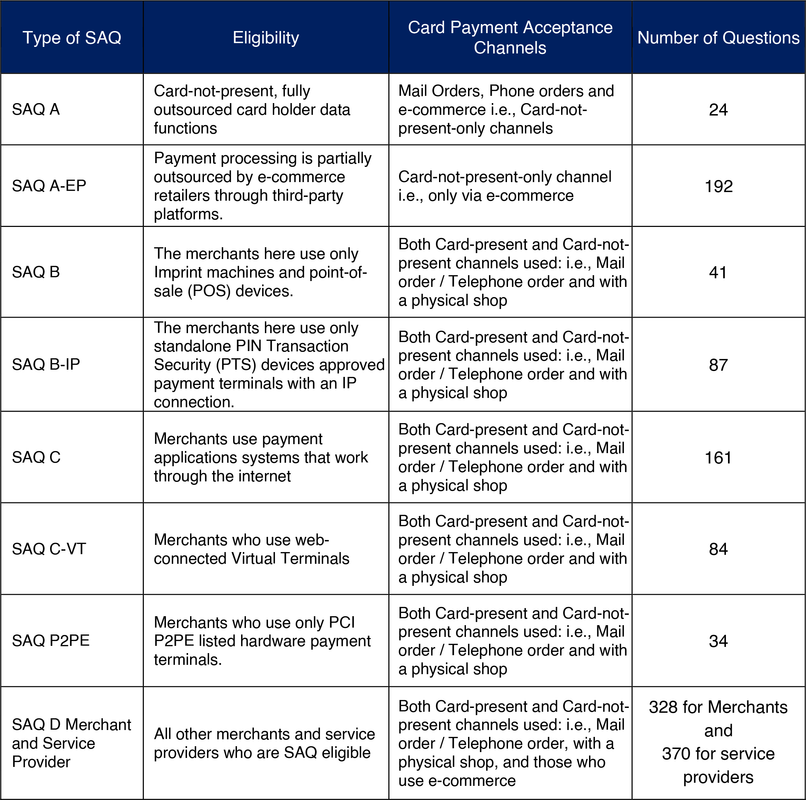
Card Usage Chat

SAQ A

Applies to you when:

  1. Your business operates with “card-not-present” transactions, e.g. eCommerce businesses and mail order/telephone order businesses.
  2. Your company does not handle cardholder data directly. You have outsourced your card handling process completely to a PCI DSS validated by a third party.
  3. The businesses that do not store, process, or transmit cardholder data in systems or premises electronically.

SAQ A-EP

The e-commerce merchants who have moderately outsourced their e-commerce payment channel to PCI-validated third parties qualify for this. They do not electronically store, process, or transmit cardholder data in their business environment.

Applies to you when:

  1. You accept only e-commerce transactions.
  2. Process all cardholder data through an outsourced PCI DSS authorized by the third party.
  3. Your e-commerce websites do not receive cardholder data but control how cardholder data is redirected to a validated third-party payment system. This is a chief argument to be considered when deciding between SAQ A and SAQ A-EP
  4. You have a website hosted by a validated third-party provider.

SAQ B

SAQ B is for merchants who are processing customers’ card information through imprint machines or standalone, dial-out terminals. They can either be card-present, or card-not-present merchants. They do not store customers’ card information on any computer or system.

Applies to you when:

  1. You use only an imprint machine and/or standalone, dial-out terminals via phone line to get customers’ card information.
  2. The standalone dial-out terminals are unrelated to any systems in your company.
  3. The standalone, dial-out terminals are not connected over an internet connection
  4. Your business is not transmitting cardholder data over an internal network or Internet.

SAQ B-IP

This is for merchants who don’t store card data in electronic format. They use IP-connected point-of-interaction (POI) devices. They handle either card-present or card-not-present transactions. They do not store card data on any computer system.

Applies to you when:

  • Your company uses only standalone, PTS-approved IP-connected POI devices to take customers’ card information in your payment processor.
  • Your standalone IP-connected POI devices are listed as authorized, in the PTS POI program
  • Your standalone IP-connected POI is not connected to any systems within your business.

SAQ C

SAQ C is for merchants whose payment applications and POS are connected to the Internet. This can include card-present or card-not-present merchants.

Applies to you when:

  • The business’s payment application and Internet connection are on the same LAN and device.
  • The payment application is not connected to any other systems of your business.
  • The POS is not  for any other locations and the LAN is also for one location only
  • Remember SAQ C does not apply to e-commerce merchants.

SAQ C-VT

This is for merchants processing card information only through standalone virtual payment terminals on a personal computer connected to the Internet.

Applies to you when:

  • The payment processing is done only through a virtual payment terminal which is called up  by an Internet-connected web browser
  • Your virtual payment terminal solution is provided by a PCI DSS authenticated third-party
  • Your company uses a virtual payment terminal solution through a computer that is separated in a single location, and is not connected to other locations or systems within your environment

SAQ P2PE

The P2PE SAQ is applicable to merchants who use a P2PE solution for their payment transactions. This reduces the number of SAQ questions to be filled. (SAQ D requires 329 questions while SAQ P2PE has only 33 questions making compliance easier)

Applies to you when:

  • All payments are processed through a validated PCI P2PE solution ( approved and listed by the PCI)
  • When you store, process or transmit account data only through Point of Interaction (POI) devices validated with PCI-listed P2PE solution
  • When you have implemented controls according to the P2PE Instruction Manual by the P2PE Solution Provider.

SAQ C-VT

This is for merchants who process cardholder data only through isolated virtual payment terminals. This may be on a personal computer on the Internet.

Applies to you when:

  • You use only a virtual payment terminal accessed by an Internet-connected web browser for payment processing.
  • Your business uses a virtual payment terminal solution through an authorized PCI DSS provider
  • You use a PCI DSS-compliant virtual payment terminal solution on a computer that is located remotely in a location not connected to other locations or systems in your business.

SAQ D

SAQ D is for those merchants who don’t meet the criteria for any other SAQ type. Those who store card data electronically and do not use a P2PE certified POS system are covered under this. E.g. Merchants not storing cardholder data electronically, but not meeting criteria of any SAQ type

Service providers qualify for SAQ D, because an institution can both be a merchant and service provider.

QRC is India renowned PCI DSS compliance Services Company spreading across its presence in over 25 countries. Having managed the journey of achieving compliance to maintaining compliance requirements of a company through its lifetime, QRC offers solutions and services to small and big businesses for the Self-Assessment Questionnaire (SAQ) remediation programme also.

Consult the experts today, they will make the process simple and handle the compliance for you.  https://www.qrcsolutionz.com/about-us