Understanding Various Levels Of Merchants Service Provider

Any Merchant and Service provider Reporting a PCI DSS Compliance by two different validation methods:

  1. Self-Assessment Questionnaire (SAQ)
  1. SAQ is a validation tool for merchants and service providers to report the results of their PCI DSS self-assessment, if they are not required to submit ROC
  2. Includes a series of yes-or-no questions for each applicable PCI DSS requirement
  3. Different SAQs available to meet different merchant environments.

B. Onsite Assessment by Qualified Security Assessor

  1. Onsite assessment is a validation mechanism for merchants and service providers by a Qualified Security Assessor (QSA)
  2. QSA submits the Report on Compliance (ROC) and attestation Of Compliance (AOC)
  3. QSA and authorized  person at merchant/service provider entity require to sign the AOC
  1. How to identify what applies to your organization? SAQ or Onsite Assessment?
  1. If you are a merchant, depends on your annual transactions per year across all channels, payment card brands defined four levels.
  2. If you are a service provider, depends on your annual transactions per year across all channels, payment card brands defined two levels.
  3. All levels, except Level 1, must complete a self-assessment questionnaire as well as have a quarterly external vulnerability scan using an Approved Scanning Vendor (ASV).
  1. Merchants PCI Compliance Levels:

Definition of Merchant: The entity directly provide service and/or Product to the End customer and get the Money through various channels. Examples like Hotels, Restaurants, Airlines, Hospitals, Online Shopping Portals etc.,

Note: Depends on the Type of SAQ Applicable for your organization, there is a need of performing Internal Vulnerability scans and Penetration testing. Read our Blog on Type of SAQ’s.

  1. Service Providers PCI Compliance Levels:

Definition of Service Provider: Business entity that is not a payment brand, directly involved in the processing, storage, or transmission of cardholder data on behalf of other entity. This also includes companies that provide services that control or could impact the security of cardholder data. Examples like Hosting Service Providers, Card Printing Services, Backup Services Providers, Managed Service Providers, Security Management, Contact Centres and/or Back office Processing companies etc.,

Receiving a Report on Compliance (ROC) and validating as a Level 1 Service Provider allows entities to be on Visa’s Global Registry of Approved Service Providers. Which will help the entities recognized  as a Trusted service provider and useful for Pitching for the new business opportunities.

PCI Standards: Picking the Right PCI SAQ

There is a quote by FBI Director, Robert Mueller – “There are two different types of companies in the world: those that have been breached and know it and those that have been breached and don’t know it.”

By just being a little cautious, we can prevent data breaches from causing downstream damages. So, reflect upon whether your systems are safe from cyberattacks? To reduce the risks of compromised data of cardholders, it is important to be PCI DSS compliant and use PCI SAQ.

What is PCI SAQ?

Payment Card Industry Self-Assessment Questionnaire (PCI SAQ) is an authentication tool to understand that merchants and service providers who accept credit/debit card payments are compliant with respect to PCI DSS, through simple questionnaires. The statement after PCI SAQ compliance testifies that your company has complied with necessary security measures and the latest version of the PCI Data Security Standards to keep cardholders’ data safe in your business.

Which PCI SAQ is right for me?

There are different SAQs that member businesses can choose from. How you use card information and how you manage card data decides the SAQ your company should fill. Different SAQs are applicable to a specific payment scenario.

It is important to choose the right SAQ because a wrong SAQ can nullify your compliance efforts and throw your business into bigger risks and breaches.

Every business is different, so every assessment is also different. To know which of the SAQ forms to complete is a challenge for merchants. Although PCI DSS has set up the processes to simplify the assessments, but it may stand as a barrier to some merchants’ motivation to complete the assessment. Companies like QRC Solutions offer facilitated SAQ programs to simply and handle the process for you.

Once you know which SAQ is right, you can complete it without hassles. Here we will try to streamline this concern by discussing each type of SAQ.

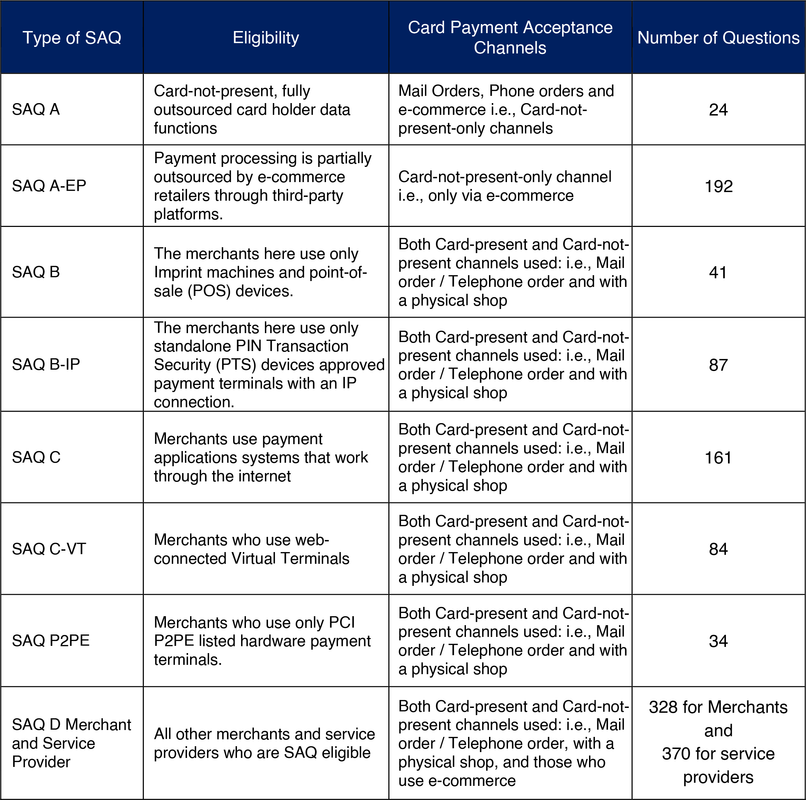
Card Usage Chat

SAQ A

Applies to you when:

  1. Your business operates with “card-not-present” transactions, e.g. eCommerce businesses and mail order/telephone order businesses.
  2. Your company does not handle cardholder data directly. You have outsourced your card handling process completely to a PCI DSS validated by a third party.
  3. The businesses that do not store, process, or transmit cardholder data in systems or premises electronically.

SAQ A-EP

The e-commerce merchants who have moderately outsourced their e-commerce payment channel to PCI-validated third parties qualify for this. They do not electronically store, process, or transmit cardholder data in their business environment.

Applies to you when:

  1. You accept only e-commerce transactions.
  2. Process all cardholder data through an outsourced PCI DSS authorized by the third party.
  3. Your e-commerce websites do not receive cardholder data but control how cardholder data is redirected to a validated third-party payment system. This is a chief argument to be considered when deciding between SAQ A and SAQ A-EP
  4. You have a website hosted by a validated third-party provider.

SAQ B

SAQ B is for merchants who are processing customers’ card information through imprint machines or standalone, dial-out terminals. They can either be card-present, or card-not-present merchants. They do not store customers’ card information on any computer or system.

Applies to you when:

  1. You use only an imprint machine and/or standalone, dial-out terminals via phone line to get customers’ card information.
  2. The standalone dial-out terminals are unrelated to any systems in your company.
  3. The standalone, dial-out terminals are not connected over an internet connection
  4. Your business is not transmitting cardholder data over an internal network or Internet.

SAQ B-IP

This is for merchants who don’t store card data in electronic format. They use IP-connected point-of-interaction (POI) devices. They handle either card-present or card-not-present transactions. They do not store card data on any computer system.

Applies to you when:

  • Your company uses only standalone, PTS-approved IP-connected POI devices to take customers’ card information in your payment processor.
  • Your standalone IP-connected POI devices are listed as authorized, in the PTS POI program
  • Your standalone IP-connected POI is not connected to any systems within your business.

SAQ C

SAQ C is for merchants whose payment applications and POS are connected to the Internet. This can include card-present or card-not-present merchants.

Applies to you when:

  • The business’s payment application and Internet connection are on the same LAN and device.
  • The payment application is not connected to any other systems of your business.
  • The POS is not  for any other locations and the LAN is also for one location only
  • Remember SAQ C does not apply to e-commerce merchants.

SAQ C-VT

This is for merchants processing card information only through standalone virtual payment terminals on a personal computer connected to the Internet.

Applies to you when:

  • The payment processing is done only through a virtual payment terminal which is called up  by an Internet-connected web browser
  • Your virtual payment terminal solution is provided by a PCI DSS authenticated third-party
  • Your company uses a virtual payment terminal solution through a computer that is separated in a single location, and is not connected to other locations or systems within your environment

SAQ P2PE

The P2PE SAQ is applicable to merchants who use a P2PE solution for their payment transactions. This reduces the number of SAQ questions to be filled. (SAQ D requires 329 questions while SAQ P2PE has only 33 questions making compliance easier)

Applies to you when:

  • All payments are processed through a validated PCI P2PE solution ( approved and listed by the PCI)
  • When you store, process or transmit account data only through Point of Interaction (POI) devices validated with PCI-listed P2PE solution
  • When you have implemented controls according to the P2PE Instruction Manual by the P2PE Solution Provider.

SAQ C-VT

This is for merchants who process cardholder data only through isolated virtual payment terminals. This may be on a personal computer on the Internet.

Applies to you when:

  • You use only a virtual payment terminal accessed by an Internet-connected web browser for payment processing.
  • Your business uses a virtual payment terminal solution through an authorized PCI DSS provider
  • You use a PCI DSS-compliant virtual payment terminal solution on a computer that is located remotely in a location not connected to other locations or systems in your business.

SAQ D

SAQ D is for those merchants who don’t meet the criteria for any other SAQ type. Those who store card data electronically and do not use a P2PE certified POS system are covered under this. E.g. Merchants not storing cardholder data electronically, but not meeting criteria of any SAQ type

Service providers qualify for SAQ D, because an institution can both be a merchant and service provider.

QRC is India renowned PCI DSS compliance Services Company spreading across its presence in over 25 countries. Having managed the journey of achieving compliance to maintaining compliance requirements of a company through its lifetime, QRC offers solutions and services to small and big businesses for the Self-Assessment Questionnaire (SAQ) remediation programme also.

Consult the experts today, they will make the process simple and handle the compliance for you.  https://www.qrcsolutionz.com/about-us

Challenges and Solutions to enable compliance pci

Challenges and solutions to better enable compliance with PCI SSF:

The PA DSS was introduced to provide a guideline for the development of payment applications. Although software security and resilience could mean a lot more than the 14 requirements of the PA DSS, the PA DSS has been the go-to when it comes to certification and validation for software security.

Now the PA DSS substituted by the PCI SSF. What is PCI SSF? How will this transition affect your organization?

PCI SSF – In brief

PCI SSF stands for Payment Card Industry Software Security Framework. It provides the standard guidelines to be followed by software companies while designing and developing payment software.

It comprised of two independent standards

The PCI SSS –  Secure Software Standard: This defines a set of requirements to ensure integrity and confidentiality of payment transactions, data, and the payment software.

The PCI SLC –  Secure Software Lifecycle Standard: This defines the basis and guidelines to design and develop the payment software, additionally it also lays down the best practices to maintain the payment software securely throughout the software lifecycle.

Although the PCI SSF is an independent set of payment security standards, it can be said that the PCI SSF takes many of its elements of control from the PA DSS standard.

So, what’s new?

PA DSS vs PCI SSF – The transition in detail, challenges, and solutions

Multiple reasons like constant change in technology, advancements in software development techniques, emerging trends in cyber-attacks have led to this transition from PA DSS to PCI SSF. The new standards of PCI SSF have comprehensive elements which would be suitable for both traditional and modern software methodologies. It has been designed in a way where every organization validating to this standard will have control over every aspect.

Let us take a look at the various aspects of differences, similarities, challenges, and solutions… Is this a change or a chance, read through to find out:

Changes and Challenges:

  • Change in Objective- Shifting to a comprehensive approach

The PA DSS was designed exclusively for the PCI DSS environment. It emphasizes majorly on cardholder information and sensitive authentication data. The PCI SSS standard mainly focuses on the integrity and confidentiality of the transaction data. The Secure Software Standard framework lays out core requirements and v1.1 has included applicability to terminal applications.

The PA DSS has certain software lifecycle and security requirements, security features of the software application within itself. The Secure Lifecycle standard focuses on how software development companies shall design their payment software.

The PCI SSF framework has prescribed clearly defined and comprehensive objective controls like Identifying dependencies between hardware and software compatibilities, providing provisions to secure the defaults, mandating a functionality within the software to retain the data securely as per payment industry methods. It evaluates how data is securely deleted. It demonstrates that the software must have a separate feature on how it is authenticating the users, how it provides role-based access control, whether it is tracking malicious activities and reporting the lags to the concerned team for analysis and prevention of lapses.

If PA DSS talks about password policy, several characters, expiry… PCI SSF ensures that these standards are not just given provision for but are implemented in the software and the customer is given awareness about the software, what kind of software it is, the user manual is provided for, the environment for usage, and the features supported, how compliant it is and how it is to be configured. Thus, making it a comprehensive approach.

  • Change in Applicability- Increased Applicability

The intent or applicability of the PA DSS and PCI SSF are quite similar, and we can say that it is a point of similarity between these two standards. The PA DSS standard is strictly applicable only to an application developer or payment application integration service that stores, processes, or transmits cardholder data as part of authorization or settlement.

The PCI SSF is applicable to any software developing company that develops payment software that is sold, distributed, or licensed to third parties. It is to be noted that this includes payment software that might be installed on a customer’s system and payment software deployed to customers “as a service” over the internet. However, it is not applicable if a company is developing software in-house for its usage or the usage of any one single customer.

The PCI SSF supports existing ways in PA DSS to demonstrate good application security and also increases the applicability of a variety of new payment software and development processes.

  • Change in the structure of the framework’s standard itself- Ensuring software security right from development:

There are currently no standards that provide a guarantee to the secure development process followed by the software companies developing software for payment industries. Although there are few requirements emphasized in the PA DSS standard on the best practices for software development, but the PCI SSF has implemented new standards in the SLC.

The PCI SLC incorporates threat identification, threat mitigation, and analysis of the risks involved, vulnerability detection and mitigation, avoiding security lapses as a part of its objective controls. SLC emphasizes on various aspects such as change management, data protection and how it is incorporated in the software, how to implement software in a specific environment, modes of third-party communication, how to reach out in case of updates to stakeholders.

Any organization implementing the SLC will give assurance to customers and stake holders of following best practices.

  • Change in criteria- Objective oriented, increased and improved security:

The new standard has opened the criteria for eligibility to be certified to increased payment software types. It supports broader array of payment software types and all software methodologies.

There are new requirements added for Terminal software. The PCI SSS objective talk about separate and exclusive controls for Terminal software. The functions performed by the terminal application needs to be documented. The design of the security features must be defined. All types of attacks that can happen need to be mitigated with in-built mechanism within the terminal application. Security testing needs to be performed so that the lapses are identified, and vulnerabilities are not taken advantage by the hackers. An implementation guide needs to be given on how it integrates with backend.

To achieve its objective of integrity and confidentiality on whole transaction data, the PCI SSS has removed dependency on technology. Now any company can get their technology validated to this standard.

Listing  Eligibility – A unique opportunity:

The intent of both the standards is same which is, to set a standard for any software company which develops software for the payment industry. Here the PCI SSF brings with it, a unique and one-of-a-kind eligibility. Once an organisation gets the validation and certification of PCI SLC, they can list their company in the PCI SSF’s list of “SLC qualified vendors”.

Procedural changes- The transition timeline:

  1. The PCI SSF was first published in Jan 2019.
  2. The last acceptance for new PA DSS submissions was closed on 30th June 2021.
  3. Companies which have not submitted ROV and AOV for their PA DSS certification yet, will have to opt for PCI SSF.
  4. If you are already PA DSS certified, minor changes can be submitted till 28th October 2022.
  5. When a product is already PA DSS certified i.e. It has been deployed to vendors the PA DSS will be acceptable for the pre-existing deployed versions of the already PA DSS certified applications.
  6. The PA DSS program closes on 28th Oct 2022.
  7. Any new application, software or updated new versions of the previously deployed applications, need to be compliant with PCI SSF.
  • Change in the assessment process- Internal training and security education:

The PA DSS validation process consists of : selecting a PA QSA, reviewing the payment application, determining if it is PA DSS compliant, submission of the ROV and AOV to council, issuance of the acceptance letter to vendor and listing on the website.

The assessment process of PCI SSF is streamlined. Certain case studies suggest that the new standard assessment can identify lapses such as implementation of attack detection methods, anomalous behaviour, usage of random number generator, execution level vulnerabilities like cache timing, branch prediction, etc.

During such assessment and gap analysis, the importance of security education within software development community increases. Providing training and evaluating the effectiveness of training provided, matures the processes and makes the organisational output more effective.

Chances and Solutions:

  • Conducting a deep interpretation of the PCI SSF framework:

It is of utmost importance to have a deep understanding of the new changes and to be prepared. The elements in the framework of the new standard might have an effect on the business factors, hence it is always better to take prior steps to facilitate necessary business operations. Having a copy of the PCI Council guide handy can go a long way in this transition.

  • Investigating the needs and analysing the standards

An analysis is the first step to achieving any goal. Be it a business goal or the PCI SSF standard. These standards demonstrate the best practices to be followed. Performing a comparative analysis on where the organization is currently with the standards prescribed by PCI SSF will bring you closer to achieving compliance. Once this analysis has been done, you can work on the requirements.

  • Know it in-and-out :

The PCI Security Standard Framework consists of Secure Software Standard (SSS) and Secure Software Lifecycle Program (SLC). The standards prescribed the basis of validation and listing eligibilities vary completely. Although they are part of the same framework, they are designed to achieve different aspects of the objective which is Software Security.

It is significant to know these differences as the security of the payment software being designed and developed can be easily achieved.

  • Staying abreast of the updates from PCI Council

Keeping a tab on updates must be kept as a constant activity during any transitions. A transition is the time announcements are made and staying prepared with updating policies and requirements can prevent last-minute lapses.

  • Professional expertise

The importance and benefits of professional guidance during such transitions are self-evident. We at QRC can help you in preparing for this transition phase. We conduct a thorough audit of your software development process as per the Secure SLC defined scope and requirements. Post assessment, we provide you with AoV, ROV Report. With new Secure SLC standards in play, you can reap the benefit of Secure SLC Annual Maintenance Service that ensures full compliance of the SLC on Recertification Assessment. You can avail services for risk identification, analysis, and management. We conduct impact analysis and provide end-to-end assistance from configuration and change management to establishing Quality Assurance Process. We also provide complete SSS Solution by reviewing, advising, security testing, conducting code review the payment software, training the development teams and helping in certification and listing in PCI SSC Secure Software Standard listing.

PCI Awareness training and how to go about it

The Payment Card Industry Security Standards Council (PCI SSC) which was formed in the year 2004 for the sole purpose of addressing these risks associated with data security, has set a standard to be followed by organizations that deal with sensitive data or otherwise known as authentication information. The PCI DSS strives to protect sensitive data, but a recent survey suggests that most PCI DSS compliant organizations are viewing this standard as a certification process rather than as an opportunity to improve their resilience. In order to emphasize the importance of the PCI DSS standard and to gain a wholesome perspective, PCI awareness training is required in every organization.

Let us look into the “Who, Why What and How?” of PCI awareness training.

Who must take the PCI awareness training?

The PCI awareness training is aimed at the employees of any organization in the payment card industry, but it can be taken by anyone who would be interested in learning about the payment card industry or any organization which must stay compliant with the PCI DSS standard.

The  12.6  of PCI DSS standards states that it is mandatory for an organization that obtains, processes, and retains payment card data to provide annual training for its staff members.

Why does an organization need PCI awareness training?

Let us take a look at the benefits of undergoing PCI awareness training:

1. We are already aware of how being PCI certified can provide a deep understanding of compliance. A PCI awareness training provides important insights way before the organization actually undergoes the assessment and certification process.

2. Through such extended insights, the employees of the organization can gain an understanding of better operational efficiency, aiding in cost management and asset management.

3. Access to know best practices across the industry in advance.

4. Eases in driving compliance and efficiency across the business organization.

What is PCI DSS Standard 12.6?

The PCI DSS 12.6 consists of a Security Awareness Program and Employee Training Requirements. It requires the organization to set up a formal security awareness program to ensure that all the employees are aware of the significance of data security. Below are the requirements of 12.6 PCI DSS :
1) 12.6.1  – Provide data security training for the employees at least annually.
2) 12.6.1.a  – Arrange training through various modes and multiple methods like corporate mailers, web module-based training, training meetings, etc.
3) 12.6.1.b  – Ensure that all the employees attend the training arranged twice, once during onboarding and regularly on an annual basis.
4) 12.6.2  – Take confirmation and acknowledgment from all the staff members that the security policies and guidelines have been communicated and understood by them.

Additionally, the PCI DSS 12.6 also suggests that the training conducted demonstrates the below points :

1. The effect of compliance of PCI DSS and the training requirements are fulfilled annually.

2. To keep implementing better understanding amongst the employees through training to ensure card data is constantly being protected.

3. Make sure that all the staff knows the requirements, roles, and procedures as given by PCI DSS.

4. Ensure that the training provided includes awareness about the financial implications caused by data breaches.

5. Security updates received every month are being communicated in a timely manner through security mailers and tips.

6. The training material includes important documents and policies which have company-specific guidelines on cyber security.

How to implement PCI awareness training?

While implementing a PCI awareness training program, it is to be given utmost importance as it can prove to be a make or break of an organization’s network and cyber governance. The most important task is to decide on a security awareness team as the PCI council has stated that a security awareness team will be responsible for “the development, delivery, and maintenance of the security awareness program”. One quick tip while taking the first and foremost step of determining a security awareness team is to choose people from a different team with different responsibilities as that way the inputs provided will be diverse and various needs of different teams will be taken care of. Once a security awareness team is determined, roles must be determined within the team.

Below are a few important things to consider while arranging a PCI awareness training :

1. Primary emphasis must be given to internal security. When internal security is emphasized, the best practices are demonstrated in a well-defined manner, and this aids while tackling the external threats.

2. Every team in the organization must be given equal awareness about the threats, vulnerabilities present within the organization so that every employee maintains the same state of mind towards cyber risk while at work.

3. The prerequisite to a good training program is well-prepared process guidelines and process documents. Compliance with security standards, certifications, existing threat levels need to be analyzed and reported. Important reports and documents need to be easily and readily available for illustrating the importance of cyber risk within the organization to the employees.

4. The arranged training sessions must be in a timely manner as vulnerabilities are constantly evolving in nature. Planning the training sessions in regular intervals and in accordance with the organization’s important milestones is important. Timing is key when it comes to training.

5. From the very first day of training, make sure that employees take initiative from their end voluntarily to protect the data security of the organization. Cyber risk security tips and awareness must be included in the day-to-day activities of the employees.

6. Holding monthly awareness campaigns with a monthly theme is a good way to implement training without affecting day-to-day productivity. Cyber risk themes like password protection, social network security, etc. can be chosen as a monthly topic for special features.

7. Sending reminder emails with cyber security tips is also an efficient way of implementing cyber security amongst employees. Email newsletters can be sent if any new guidelines are implemented.

8. Intranet portals must be actively used to access the important reports and documents used during the annual training sessions. This way, employees will always have sufficient access to cyber security guidelines.

12 requirements of the PCI DSS Compliance

Electronic payments are all over the world today, owing to the convenience of time and effort it gives to the users. From small vendors to big corporates, are all offering card payments as an alternative payment method to augment their selling opportunities. Nevertheless, a user’s card information is sensitive and to process this information is attached with risk and accountability. Securing this personal data from thefts and frauds is the duty of merchants as per PCI DSS. (Payments Card Industry Data Security Standards). PCI DSS intends to reduce the risk of card fraud and increase the security controls for cardholder data.

What is PCI DSS?

Information relating to Credit cards is extremely vulnerable, as data thefts have turned predominant now. Credit card theft is the second most common type of theft and the amount of fraud by new credit card accounts saw a 48% increase from 2019.

The  PCI DSS  is a compliance standard set for data security requirements concerning the handling, storing, or transmission of cardholders’ data. Leading card brands Visa, MasterCard, American Express, Discover and JCB collaborated to form PCI SSC which is an independent council that maintains and updates PCI standards.

To whom does it apply?

PCI DSS applies globally to all big and small merchants, also the service providers who store, process, or transmit cardholder information. PCI necessitates card holder data, sensitive authentication data to be made compliant by the companies and maintained as merchants use such data. If a payment card carries the logo of any of the above-said PCI’s founding card brands, it must be protected as per PCI DSS.

Requirements of PCI DSS Compliance

PCI DSS is your roadmap to card data security compliance by fulfilling the 12 requirements listed in the standard. Following are the 12 Requirements under PCI DSS for card data securitization.

  • Step 1) Install and maintain a firewall configuration to protect cardholder data– Firewalls are the first line of defence against hackers, so have the firewall and routers configured properly. This firewall must set the rules to what kind of traffics can be allowed inside your corporate network
  • Step 2) Do not use vendor-supplied defaults for system passwords and other security parameters – Remove Vendor supplied default settings for all software, network devices, and servers. Using default settings, usernames and passwords are simple to guess putting access to the device at risk. Upgrade your settings for all devices and maintain documentation for these high-security configurations
  • Step 3) Protect stored cardholder data- Use ‘encryption key management process’ to encrypt card data and protect the encryption keys also. It requires creating a Card Holder (CHD) Flow to document how the cardholder data flows in the organization. PCI demands the use of discovery tools to locate and secure unencrypted PAN and other vulnerable data.
  • Step 4) Encrypt cardholder data transmitted across open, public networks – This step focuses on securing the data in transmission. As the hacker’s eye on the data on the transit, PCI requires encryption of data before transmission.
  • Step 5) Protect all systems against malware and regularly update anti-virus software or programs – Install anti-virus on all hardware and software devices. Make sure that the anti-virus does continuous monitoring and generates logs on a regular basis.
  • Step 6) Develop secure systems and applications – Conduct a thorough risk assessment to implement processes for deployment of technology. It is important to update and patch internet browsers, applications, databases, firewalls, POS terminals, and OS in the card flow path within a month of its release.
  • Step 7) Restrict cardholder data on a need-to-know basis – This step requires having a role-based access control (RBAC). It allows access to card holder’s data only to individuals who need it for business purposes, through keycards and passcodes.
  • Step 8) Identify and authenticate access to system components – This PCI DSS step requires, every individual user to have a separate and unique password and username. Group and shared passwords must never be used. This step helps to trace back the activity in the event of an internal data breach.
  • Step 9) Restrict physical access to cardholder data – PCI DSS directs to have electronic monitoring of entry-exit of file storage and data center locations. These video recordings must be preserved for 90 days and there needs to be a process to identify between employees and visitors.
  • Step 10) Track and monitor all access to network resources and cardholder data – This step mandates monitoring and protection of all network systems with a clear history of activities. These activity logs must be centrally monitored daily, time-synchronized, and maintained for 1 year at least.
  • Step 11) Regularly test security systems and processes – Due to the constant eyeing of cybercriminals, PCI requires merchants to have a continuous process and system testing. Create plans for vulnerability scanning and penetration testing as specified by PCI DSS.
  • Step 12) Documenting and maintaining risk assessments – This step involves creating, maintaining, and implementing a security policy for the company covering its employees, management, and third parties. The policies must be reviewed annually as well.

Consequences of Non-compliance

Theft or breach of card data badly affects the entire payments ecosystem. Here are a few consequences one may have to face for non-compliance with PCI standards.

Penalties – PCI DSS non-compliance can result in penalties from the card companies. Fines depend upon the volume of payments handled by the merchant in question. Penalties may vary from $ 50 per cardholder and peak up to a total of $100,000 per month. The bigger companies that operate with volume frequently get audited for PCI Compliance and they may decide to levy penalties in case of non-compliance.

Revenue loss and damaged reputation -Due to data breach, there can be loss of trust among customers which can lead to loss of credibility and personal fallouts. The business that is lost is the largest consequence of data breach. It is extremely hard to recover from data breaches because the losses get greater than the data itself in such scenarios and impacts organizations for years.

Legal action – Even though PCI DSS is not a legal requirement, in an event of data breach, the affecting parties can take legal action. In 2007, $40.9 M was compensated by TJX for exposing 100 million card holders’ information.

How to Make PCI Compliance Easy and Cost-Effective?

Here we are trying to burst the mythos that  PCI Compliance  can be stressful, expensive, and time-consuming. These are a few things that make sure that your budgets are not hit hard for ensuring compliance.

  1. Install patches and updates regularly to avoid technology and additional staffing costs on the security team.
  2. Train the development team on secure coding best practices. This will reduce much vulnerability from the start and reduce remediation costs.
  3. Keep up with the changing PCI standards. In case you fall short of complying with the latest standards, reassessments are required. Reassessments involve audits which are further time-consuming and expensive.
  4. Send your key personnel on Compliance training courses so that they can understand the most relevant risks that apply to your organization. This further reduces reassessment and audit costs.

QRC as a leading PCI Qualified Security Assessor Company

Being a PCI QSA, QRC helps businesses to highlight gaps in their compliance posture whether it is a SAQs Assessment or the complete  PCI DSS certification, supporting end-to-end in compliance journey with complete confidence.

As a certified PCI Qualified Security Assessor Company, QRC can certify your organization and process for PCI DSS compliance. We also offer other PCI security standards like  PCI 3DS,  PCI SSF  etc. QRC provides these services to give organizations across the globe an edge of being a completely security compliant business organization. Our security assessment services cover all aspects of the technology infrastructure (Web, API, Network, Cloud Assets, Servers)that has helped our clients to streamline data security processes and practices over the years.

What is Payment Card Industry Data Security compliance?

Understand the Payment Card Industry Data Security Standard requirements and how the critical role it plays under placing a robust benefit on successful enforcement of the PCI DSS compliance program.

Developed and launched by the founding payment brands of  PCI Security Standards Council (PCI SSC)  in 2006, the Payment Card Industry Data Security Standard (PCI DSS) is a standardized, industry-wide set of requirements and processes for security management, policies, procedures, network architecture, software design, and critical protective measures.

The requirements stated for PCI DSS compliance are essential to ensure that all entities that process, store, or transmit payment card information maintain a secure environment to prevent any security incident. Though the PCI DSS is not a law, it holds a strong contractual obligation to be applied and enforced through fines or other restrictions – directly by the payment providers themselves.

Here we will have a look at :

  • Overview of the PCI DSS
  • 12 Requirements for PCI DSS compliance
  • PCI DSS compliance  Benefits
  • Difficulties Posed by PCI Non-Compliance
  • Conclusion

Overview of the PCI DSS

PCI DSS has been put forth as the benchmark standard compliance program for the security and protection of the cardholder data, The standard applies to any business IT system or operation that involves any stage of storing, processing, or transmitting the cardholder data. Successful implementation of the controls defined under the PCI DSS makes it more difficult for the attackers to steal sensitive data promoting security and assurance to multiple parties involved in the payment processing cycle like Payment Card Brands, Issuers, Merchants, and Acquirers, etc.PCI DSS Implementation does not require any special grade countermeasures but focuses on placing a minimum baseline to help organizations defend their business against their attackers.

Aiding the successful implementation of the  PCI DSS compliance program, the PCI SSC council has provided a set of resources to aid any organization that seeks to implement or attain  PCI DSS compliance. Along with other key documents, the security council has provided:

  • PCI Data Security Standard quick reference guide and approach
  • PCI Software Security Framework  and a list of Validated Payment vendors and applications under its Secure Software Standard and Secure Software Lifecycle Standard to help payment software vendors adhere to security practices in the development cycle and software.
  • PCI PIN Transaction Security (PTS) requirements for device vendors and manufacturers, along with a list of approved PIN transaction devices
  • Self-Assessment Questionnaires templates in aiding organizations to validate their PCI DSS compliance.
  • List of Qualified Security Assessors (QSAs) for the multiple compliance standards
  • List of Approved Scanning Vendors (ASVs)
  • An Internal Security Assessor (ISA) education program

The council also provides resources for Card production, PIN, TSP (Token Service Providers), and contactless payments, etc.

12 Requirements for  PCI DSS compliance

The PCI DSS compliance program has seen major changes over the years, The latest versions  groups the  12 PCI DSS requirements, in the six principles stated are as follows:

Implementation of Secure Network Infrastructure

  1. Install and maintain a secure firewall
    Network firewalls can be software or hardware technologies that provide the first line of defense to a network. Firewalls can restrict incoming and outgoing network traffic
    through rules and criteria configured by your organization. Being the first line of defense against cyber threats and their effectiveness, firewalls are required for PCI DSS compliance.
  2. Password protection policy
    Implementation of adequate configuration standards for networking devices and applications in the enterprise is necessary. Using third-party products with generic passwords lowers the effectiveness of the security measures, making the systems easily accessed by the public. IT heads need to maintain and update asset inventory along with a strict policy for password usage and configuration, to ensure PCI DSS compliance.
    Secure Cardholder Data
  3. Protect Cardholder data
    The third requirement is designed to minimize the impact of an attacker managing to compromise your network and system components to gain unauthorized access to your data stores. To effectively reduce the risk of unauthorized access, it is necessary that data retention is kept to an absolute minimum and the stored data is protected using Encryption, Tokenization (with effective supporting practices), and so on.
    Regular scanning and maintenance of the cardholder data environment are required to ensure that no unencrypted data exists, to maintain PCI DSS compliance.
  4. Encrypt cardholder data across the network
    Much like “Cash In Transit,” cardholder data is sent across multiple channels as per requirement. This makes it necessary to ensure that the sensitive cardholder data is encrypted when transiting over public-facing environments.
    Maintain a Vulnerability Management Program
  5. Install and maintain an antivirus program
    Cybercriminals are constantly evolving malware strains, hence all the devices that require an antivirus program must be installed. The program needs to be patched and updated regularly. With evolving security requirements, it’s essential that asset security programs remain updated and to ensure that the controls remain effective.
    The audit logs help you to verify compliance with PCI DSS assessment, without which one would be unaware of an unauthorized browser extension or malware that can read PANs as they are entered into a payment application. 
  6. Maintain strong system and application
    Application developers can never be perfect hence it is necessary to update/patch security holes, a cybercriminal will pass the security vulnerabilities across the hacker community to exploit the weakness until the systems are patched. The software development process must be carried out securely to ensure no new vulnerabilities are introduced.
    All changes must be managed, to document the supporting risk-based
    decisions made (e.g., Impact, Rollback options, etc. The updates are necessary for all software on devices that are used to manage cardholder data.
    Implement Strong Access Control Measures
  7. Restrict access to cardholder data
    Isolating access rights is nowhere crucial than the payment cardholder data. The merchants need to ensure that managing employees grant access rights to the least amount of data that are necessary to perform any action.
    It’s necessary to establish an access control system for each element of the cardholder data infrastructure, and all access rights must be set by default to ‘deny all’ unless an individual is specifically allowed access to designated cardholder data.
  8. Authentication policy for access to system components
    Any person who has access to cardholder data should have individual credentials for access identification. Unique IDs and authentication methods (passwords/token devices/biometrics) should be used for everyone. Prohibit shared/generic accounts and implement Two-factor authentication for remote access.
  9. Restrict physical access
    Merchants need to restrict physical access to cardholder data or systems that house cardholder data – including hardcopies, stored in a secure location to manage PCI DSS compliance.
    The card environment should have physical security controls and procedures for the identification and management of any visitors to the premises.
    Regularly Monitor and Test Networks
  10. Monitor and maintain access logs
    All activities concerning handling and managing cardholder data need to have a log entry associated with them. The logging mechanisms are necessary for vulnerability management. Merchants must create a process that links all access by individual users to
    cardholder system components that will enable you to reconstruct and record events.– especially when done with administrative privileges.
    The ability to produce detailed audit reports on demand is important for  PCI  DSS  compliance.
  11. Regularly test security systems and processes
    New vulnerabilities are discovered daily and hence PCI DSS requires merchants to regularly test cardholder data systems and processes to find those vulnerabilities and fix them.  Vulnerability scans  for both internal and external networks (at least quarterly) and penetration testing (network and application layer) are required.
    Network and host-based IDS or IPS are to be managed and maintained along with a system to monitor file integrity.
    Maintain an Information Security Policy
  12. Document and maintain policies that address information security for all personnel
    PCI DSS compliance  requires merchants to maintain a policy that addresses information security for all personnel. The policies determine the nature of the controls used to ensure security and comply with PCI requirements that apply to each component in the cardholder data environment like – PIN entry devices, servers, network services, applications, PCs, and other endpoints.

PCI Compliance Benefits

Cybercriminals are opportunists that seek to exploit the misinterpretation/misapplication of the PCI DSS controls, poorly managed PCI DSS oversight, bad practices, or poor risk management processes. Even though the process of complying is a very daunting task, yet its importance is growing over time. The process of gaining  PCI DSS compliance  with the right tools can be completed with ease even considering the maze of standards and issues.

The compliance benefits can be counted as follows :

  • Ensure system security and develop customer trust, confidence and manage system security that ensures trust for businesses
  • Reduce the risk of security breaches by ensuring application security and loophole closure concerning Cardholder Date and Cardholder Data Environment.
  • An increase in business prospects as being the  PCI compliance  stature promotes one as a secure business ensuring growth in reputation.
  • An organization that complies with PCI DSS should be able to decrease the data breach significantly. Being compliant with PCI DSS ensures that the company has a strong commitment to protecting its data, improving customer relationships.
  • Gaining  PCI DSS compliance  will prepare you better with other privacy and regulation standards like ISMS,HIPAA, SOX,  GDPR, etc.
  • Successful implementation will lead to the overall improvement of IT infrastructure efficiency.

Difficulties Posed by PCI Non-Compliance

PCI DSS compliance is treated as an annual “tick box” audit however, this is far from reality where PCI DSS should be treated more like having the responsibility for owning and running couriers, road haulage, or taxi services. The increasing dependency on electronic payment systems has increased its regard in the eyes of cybercriminals. This ever-growing trend toward payment cards increases the potential opportunities for criminals to exploit poor practices.

Failing to noncompliance would result into :

  • Data breach incidents that affect consumers, financial institutions along with severe damage to the company brand.
  • In addition to the loss of brand reputation, a merchant should expect their revenue to drop drastically owing to the loss of clients followed by a security incident.
  • Legal actions, insurance claims. government fines and lawsuits and canceled accounts.

Conclusion

The PCI DSS compliance poses a challenge to every business that’s not rightly prepared and looking forward to gaining the PCI DSS compliance status. PCI DSS continues to evolve based upon mature and well-established industry best practices. Consequently, to repay the consumer trust and to reduce the attractiveness to criminals, businesses must understand the heritage of the PCI DSS controls to better enable them to develop robust defenses.

PCI DSS Certification – Common Controls failures

Data breach incidents are becoming incredibly common, and a significant reason behind it is organizations careless in taking necessary precautions in securing their vital network and systems. The revenue loss stats from last year mount up to  $24.26  billion let alone due to payment card fraud.

PCI Data Security Standard or PCI DSS as it is abbreviated is a set of technical and operational requirements for any organization that accepts, stores or transmits any cardholder data in a payment processing ecosystem. The standard serves as a guideline for organizations to up their defences and significantly reduce the chances of suffering from any data breach incidents that cost in reputation and revenue.

Read about the  PCI DSS  standard here.

In a survey taken last week on the most common pain point in the implementation of PCI DSS, 57% of the audience voted for accurately defining the scope for the assessment. These inconsistencies eventually end up in security loopholes that hackers exploit and get their hands on the sensitive card data.

Common Failures in PCI DSS Implementation :

Inaccurate Scoping : 

Accurate scoping of the cardholder data environment is necessary. In a survey taken last week on the most common pain point in the implementation of PCI DSS,  57%  of the audience voted for accurately defining the scope for the assessment. These inconsistencies eventually end up in security loopholes that hackers exploit and get their hands on the sensitive card data.

Scoping of the cardholder data environment (CDE) will include all the aspects of people, process and technologies that are involved in handling the cardholder data. Organizations reduce the PCI DSS scope by means of  network segmentation however, threat actors would be able to enter from a less secure area if the segmentation is done improperly.

Storage of sensitive authentication data (SAD) :
Many organizations unawarely store sensitive authentication data even after authorization. PCI only allows  SAD  for payment processing, and no data is to be stored post-authorization.

Default System Credentials and Settings :
Post workstation and device setup, default system settings and passwords are mandated to be changed, failing this leaves open doors for the system access for hackers

Outdated Security Patches :
Technology is ever-evolving, and hence any software application has a short life cycle, the one that is sustained by ongoing updates and upgrades. Hence having outdated security patches still running on the system opens considerable risks and vulnerabilities.As per the PCI requirement, it is necessary to keep the system security patches updated.

Poor Encryption Key Management Policy :
Modern cryptographic algorithms, when implemented correctly, are highly resistant to attack – their only weak point is their keys, and the biggest challenge is the efficient utilization of encryption and tokenization.

The value of any cryptographic key is equivalent to the value of all the data and/or assets it is used to protect. It’s necessary to adhere to the essential controls regarding Key storage, policy management, authentication and authorization.

Inefficient Log Management :
Insufficient logging has been the bedrock of nearly every major incident. The lack of monitoring and timely response helps attackers to achieve their goals without being detected. Hence it is necessary to ensure that audit trails for all the essential processes like Individual usage with cardholder data, administrative activities, invalid access attempts, tracks of audit log clearings and access restrictions for jobs related.

Insufficient Monitoring Policy :
Attackers rely on the lack of monitoring and timely response, in order to achieve their goals without being detected. Consistent monitoring, regular log review, usage of IDS / IPS, conducting Quarterly vulnerability scan and change detection mechanism are few steps to implement efficient monitoring mechanisms.

Poor Access control policies :
Improper access control policies expose an organization to unauthorized access of data and programs, fraud, or the shutdown of computer services. As an organization’s network extends board, external threats become more critical to be considered while implementing security measures.

Failing to address PCI DSS compliance in Quarterly or Semiannual security assessment:
Once PCI DSS certified, organizations tend to fail to continually address the compliance requirements in their quarterly or semiannual security assessments. As a part of business, as usual, it’s necessary to flag and investigate any exceptions that occur in the course of daily operations.

PCI SSC council announces updates for PTS POI.

PCI SSC announced and published new updates in the PCI PIN Transaction Security (PTS) Point-of-Interaction (POI) Modular Security Requirements v6.0 standard. With new advancements made in the payment ecosystem, new applications and payment device technology, it’s necessary to safeguard and secure controls against cybercriminals who are developing new ways to breach systems storing sensitive payment data.

The PTS POI standard was developed to protect the PINs and cardholder data on magnetic stripe or the chip of an EMV card used along the mobile device. The latest version 6.0 includes key requirements and changes related to :-

  • Restructuring key modules into Physical and Logical, Integration, Communications and Interfaces, and Life Cycle to reflect the diversity of devices supported under the standard and the application of requirements based upon their individual characteristics and functionalities.
  • Ensuring ongoing protection by limiting the firmware approval timeframe to three years.
  • Including requirements for devices that accept EMV enabled cards to support Elliptic Curve Cryptography (ECC), facilitating the EMV migration to a more robust level of cryptography.
  • Enhancing support for accepting the magnetic stripe cards in mobile payments using solutions that follow the Software-Based PIN Entry on COTS (SPoC) Standard.

The in detail documents related to the PTS POI v6.0 Standard has been updated at the  PCI SSC document library. The documents are as stated below:

As a forerunner on the cybersecurity front, QRC supports their customers to establish, document, implement and maintain Data Security and Privacy frameworks to protect their sensitive data from all Internal / External Threats and manage the confidentiality, Integrity, availability, Security, Privacy of such information systematically.

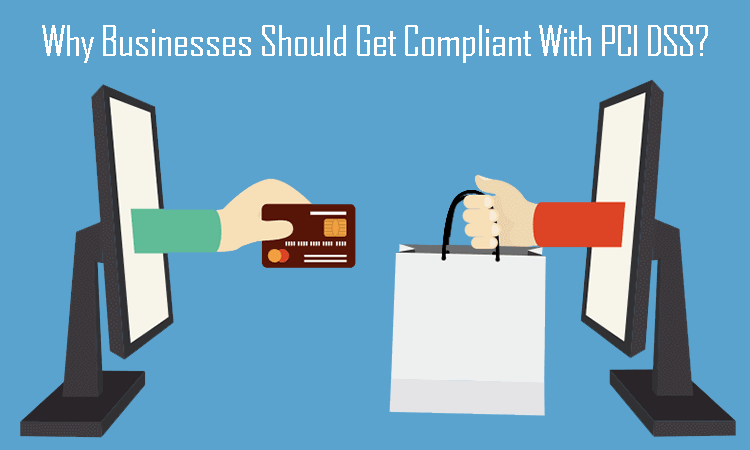
Why Businesses Should Get Compliant With PCI DSS?

Over the last few years, ‘data breach’ has been one of the most fearful phrases in the payment industry. We have seen the effect of data breaches time and again over the years, and how it can bring a company down to its knees. In fact, Target’s 2013 data breach is still whispered with fear thanks to contact details of over 70 million customers being hacked. As it was back then and now, the simple question remains – why did it happen and what can be done to ensure it does not happen again?

In the simplest sense, the lack of security or compliance of required security says it all. Over time, experts too have pointed out that a stringent compliance has to be in place when it comes to data security. The answer is PCI DSS. These security standards helps facilitate consistent and remarkable security.

How does PCI DSS compliance help?

Quite simply, having a compliance like payment card industry data security standard will ensure that you have improved controls to reduce payment method frauds. The compliance levels stems right from the storage and the encryption of the credit cardholder, irrespective of the transaction size. How does this help? Well, it protects your company from a breach of data. A  PCI DSS Compliance India  would help your company rise up to the next level because –

A confident customer is a customer forever : Giving your customer the confidence that their data is completely safe on your platform is going to be the foundation for years to come. It is essential to keep your business running and to keep the transactional model flowing.

Keeping your data secure : Information of your company employees, clients and business payment methods, is undoubtedly the most important asset to any organisation. The risk of malpractice can be devastating – so can unauthorized access or hacking. When you have a  PCI DSS consultant  in your team, you can protect this data from any form of access. Not only does that become the strength of your business, but it also protects the value of transaction.

Keeping ahead of the game : Having a standard of this kind implemented in your business keeps you way ahead of the possible threats ahead. It is not only the payment methods or data that you are keeping safe, but you are looking ahead of further possible threats that may be in the way for your business. It gives you that additional push to focus on everything else your business needs to thrive on and will be the driving force to your higher growth. Plus, such a compliance is tailor made for your business as it cannot be implemented with one business model in mind – the specific rules that apply to your industry and business model are unique a massive advantage in today’s game.

Does Business Need PCI DSS Readiness Assessment?

Understanding the need of PCI DSS in your industry is the first step towards securing your business. The amount of risk is tremendous without it. Not too long ago, massive retail chain Target revealed that credit and debit card information of 40 million customers had been compromised in a cyber-attack. Such an attack can have disastrous impacts on the business of a huge brand like Target – let along imagine the consequences to deal with in a smaller company.

Before you even look at analysing if your business needs PCI DSS, you need to know what a standard like this does to your business. In the simplest form –

  1. It builds and maintains a secure network
  2. Keeps all the cardholder data and information safe
  3. Prepares strong access control measures all the time
  4. Analyse and review a vulnerability management program
  5. Test the networks regularly
  6. Maintain a policy towards information security.

Pre-analysis of your compliance

Now, to have this implemented, you first need to schedule an official PCI audit which would validate your company’s compliance. This is called a PCI DSS gap assessment and will uncover any security issues that may be present. Apart from this, a self-assessment questionnaire would deeply help understand if such a system would be feasible for your business too. To do this, you need to

  1. Review your existing infrastructure right from the network to the access control.
  2. Understand where your cardholder data is stored, processed or transmitted in your system.
  3. Create a baseline scope or present status for the PCI compliance.
  4. Identify the difference between the scope and the requirements

Many businesses miss out the key benefits of having such a certification. One of our clients (newly formed small-business), wanted to look at having PCI DSS gap assessment done for their business. Of course, they had compliance issues and up-scaling their present infrastructure would cost them a lot of money.

As per recommendations, a  PCI DSS Gap Assessment  was done which saved them the entire upgrade – plus implementing the changes on this gap assessment, we were able to change many controls which not only simplified their annual assessment but also reduced the costs that were attached to it.

A simple assessment can go a long way in not only creating a better structure within your business, maintaining quality but also in saving you or your client a lot of money. Moreover, being compliant gives you a huge advantage over other competitors too as well as gives your clientele a lot of confidence in your services. If you are looking for an assessment of this kind, reach out to us and we’d be happy to help.